Marine mammals continue to wash ashore in Ghana’s Western Region
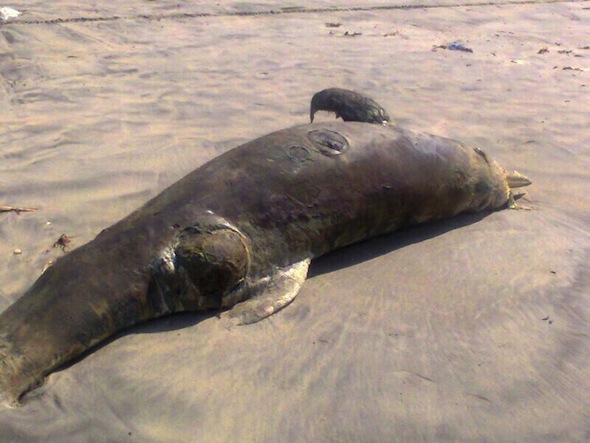
October 21st, 2013: the 19th marine mammal to wash ashore in Ghana’s Western Region since 2009. Photo: Friends of the Nation
From Friends of the Nation, Takoradi, October 23, 2013
The washing ashore of marine mammals in Ghana is still not stopping. On October 20 and 21, 2013, two more mammals were found dead at the coast of Asanta in the Ellembelle District in the Western Region. These carcasses present the 18th and 19th incidents respectively within the last four years. Citizens in the coastal areas are trying to correlate these unfortunate events to the offshore oil and gas, since the production started around the same period (2009). Two dead mammals after each other within just two days caused a shock amongst locals. People in the coastal community are asking for answers.
Chad’s oil: 10 year anniversary, nothing much to celebrate
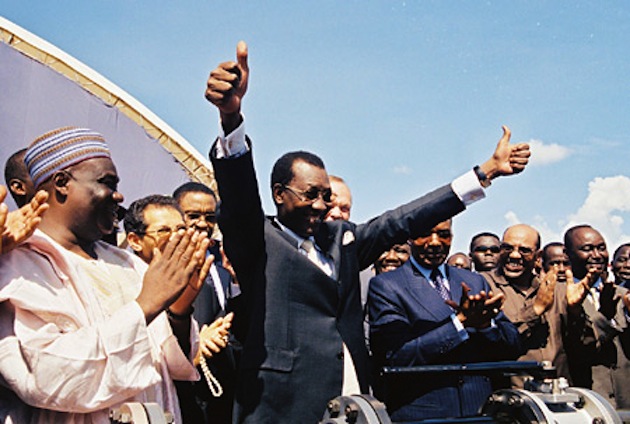
A crowning achievement! October 10, 2003
It was on October 10th 2003 that Exxon Mobil and its partners officially inaugurated the Chad-Cameroon Oil Project. The press release marking the event was positively jubilant:
Addressing inauguration attendees, Morris Foster, president of ExxonMobil Development Company, said, “It is with great pride that I am here today to celebrate this tremendous accomplishment with everyone who has been involved in the Project. I want to personally thank President Deby and President Biya for their support along with important contributions of our co-venturers, Petronas and ChevronTexaco, and the World Bank Group for their commitment to this Project.
“Today we celebrate not only what was achieved during the construction but Esso, as operator, also celebrates the manner in which it has been accomplished,” Mr. Foster added. “We maintained our long-term focus on this project over 27 years of effort and changes in the consortium, increased the known oil reserves to commercial levels and helped turn a vision in 1976 into a reality. We believe this project will help prepare a brighter future for the citizens of Chad and Cameroon, and I am proud we are part of it.”
U.S. sends mixed messages on transparency
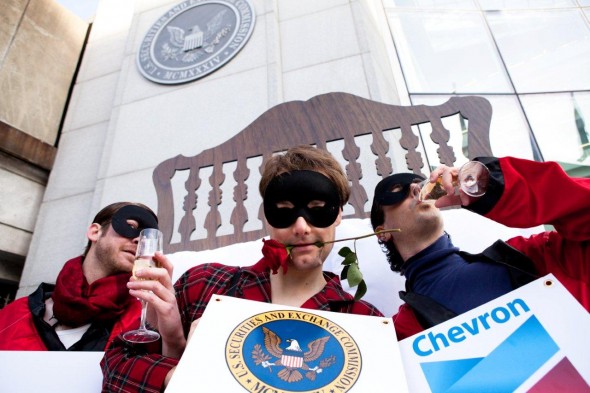
S.E.C. in bed with the oil companies? Oxfam event in front of S.E.C., February 10, 2012. Photo: Oxfam America
The big news that came out of Obama’s recent trip to Africa was the announcement of his “Power Africa” initiative. The initiative has been praised and criticized, but I’ll just note the last few paragraphs of the White House Fact Sheet that discuss transparency — almost as an afterthought:
Transparent Natural Resource Management
The recent discoveries of oil and gas in sub-Saharan Africa will play a critical role in defining the region’s prospects for economic growth and stability, as well as contributing to broader near-term global energy security. Yet existing infrastructure in the region is inadequate to ensure that both on- and off-shore resources provide on-shore benefits and can be accessed to meet the region’s electricity generation needs.
Although many countries have legal and regulatory structures in place governing the use of natural resources, these are often inadequate. They fail to comply with international standards of good governance, or do not provide for the transparent and responsible financial management of these resources.
Power Africa will work in collaboration with partner countries to ensure the path forward on oil and gas development maximizes the benefits to the people of Africa, while also ensuring that development proceeds in a timely, financially sound, inclusive, transparent and environmentally sustainable manner.
Exxon fails to address pipeline safety risks, fined $1.7 million
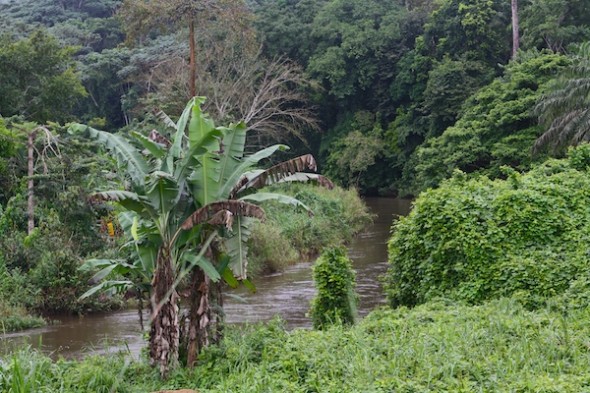
One of the many rivers that the Chad-Cameroon oil pipeline crosses. Photo by Christiane Badgley
“The U.S. Department of Transportation on Monday hit Exxon Mobil Corp. with a $1.7 million fine over a July 2011 pipeline failure that dumped more than 60,000 gallons of oil into Montana’s Yellowstone River after concluding the oil giant failed to effectively address pipeline safety risks,” writes Sean McLernon in the March 26th edition of Law360.
According to a news release from the Department of Transportation’s Pipeline and Hazardous Materials Safety Administration (PHMSA), “ExxonMobil failed to properly address known seasonal flooding risks to the safety of its pipeline system, including excessive river scour and erosion, and to implement measures that would have mitigated a spill into a waterway.”
I wrote about the Yellowstone River spill in September 2011 asking what lessons the Montana accident might have for Cameroon. To recap what I said then, environmentalists in Cameroon and Chad have long been concerned about the safety of the 1070 km Chad-Cameroon oil pipeline and have stated repeatedly that COTCO (Exxon Mobil pipeline operations in Cameroon) has not provided reliable information about its real capacity to respond in the event of an oil spill. Much of the pipeline crosses relatively remote and hard-to-access areas (few or no roads) and many question COTCO’s assertions that response teams could quickly travel to the scene of any incident.
More elections in Cameroon. Does anyone care?
Nearly 20 years after deciding that Cameroon needed a Senate, President Paul Biya recently announced that the country’s first Senate elections will be held on April 14, 2013. He made the surprise announcement at the end of February, leaving little time to organize a credible election.
Voters will elect 70 senators, while Biya will hand-pick the remaining 30, according the presidential decree read over state radio.
The SDF, Cameroon’s main opposition party, loudly denounced the elections and pledged a boycott, then in a awkward volte face several days later, agreed to participate. SDF party members now say the party will participate in the Senate elections as it does not think Biya, 80, will make it to the end of his term.
According to the Cameroonian constitution, the head of the Senate would assume the interim in the event of a mid-term presidential vacancy.
Biya’s planned senatorial elections seem to indicate that he is interested in perpetuating the status quo of Cameroonian politics into the post-Biya era.
East Africa and the resource curse: Where are the jobs, where is the power?
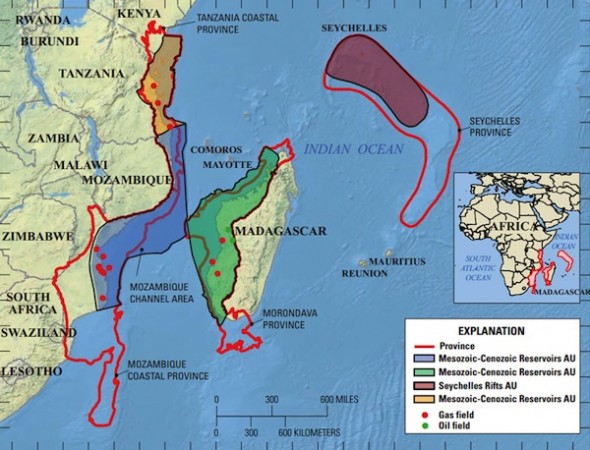
Lots of oil and gas, but will this translate into electricity and jobs? Map Credit: U.S. Geological Survey.
I’m catching up on news and have come across another recent article about East Africa’s oil and gas development. Avoiding the Resource Curse in East Africa’s Oil and Natural Gas Boom, draws attention to a fundamental problem with oil and gas development across Africa: minimal job creation and little or no increase in power (electricity).
Can any government really call oil a “blessing” if it doesn’t bring employment and power to the population?
The author, Jill Shankleman, is a senior scholar at the Wilson Center and former senior social and environmental specialist at the World Bank. “Up to now,” she writes, “oil companies and governments in developing countries have worked on a narrow model of economic benefit. Oil companies produce oil (and gas) for export. The government gets a hefty share of the profit in the form of taxes and product. To a greater or (often) lesser degree, efforts are then made to open up employment and supply chain opportunities locally.
“Where this model applies in West Africa, it is typical to find huge, state-of-the-art oil and gas export facilities sitting alongside communities where people live in houses without electricity. People like me who are involved in community consultations always hear the same thing when we speak with locals: ‘Where are the jobs? And why are we living in darkness next to this place which is stealing our oil?’”
Shell in the Niger Delta: the endless wait for clean-up
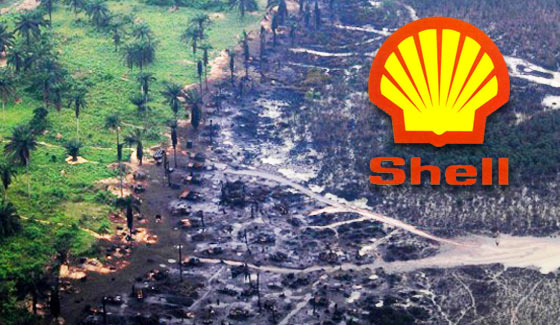
Photo from Sum of Us: Fighting for people over profits. http://sumofus.org/campaigns/shell-cleanup/
A team of assessors from the U.K. has just returned from a fact-finding mission to the Niger Delta and has slammed Shell for failing to clean-up pollution resulting from two 2008 spills. “Next to nothing has happened and where work has commenced it has been totally amateurish,” said said Martyn Day of the London-based law firm Leigh Day, speaking to John Vidal, environment editor at The Guardian.
You can read the article, Shell attacked over four-year delay in Niger Delta oil spill clean-up, for more details on Shell’s failure to get serious about cleaning up the extensive damage from the spills.
This is merely the latest in a series of damning critiques of Shell’s failure to clean up its pollution. Shell initially denied responsibility for the spills and when the company did accept responsibility it “dramatically underestimated the quantities” of oil spilled.
Thoughts on ExxonMobil from China

Photo by Christiane Badgley
I’m writing from Guangzhou, China, where I’m spending a few days working with the city’s Nigerian community. This work is not directly related to oil, although it’s not hard to make the connection. The corrosive impact of oil on the Nigerian economy (and society more generally) comes up again and again in conversations.
How many Nigerians have left their country because of its oil-generated “wealth”?
World Bank approves loan for Cameroon’s Lom Pangar dam
Photo: World Bank
Once again the World Bank has signed on to a high-risk project with questionable poverty-reduction potential.
Of course, reading the press release from the World Bank, you would never guess that this project could be anything less than wonderful:
WASHINGTON, March 27, 2012 – The World Bank’s Board of Executive Directors today approved US$132 million in zero-interest financing for Cameroon’s Lom Pangar Hydropower Project (LPHP), to support the country’s economic development and significantly improve the supply of electricity to homes and businesses across Cameroon.
Bonga spill investigation ordered
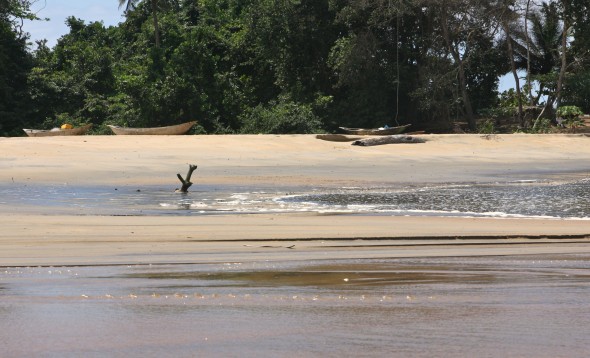
When will protection of the environment become a priority? Photo: Christiane Badgley
The Nigerian government has mandated an investigation into the cause and effect of the Bonga oil spill on December 20th.
An NGO has also raised questions regarding Shell’s use of dispersants without any monitoring or assessment plan.
Fishermen are blaming the spill for a dwindling fish supply and rising prices.
Meanwhile, Shell is moving ahead with its plans to drill in the Arctic waters off Alaska.
“The polluter is strangely in charge of the regulators.”
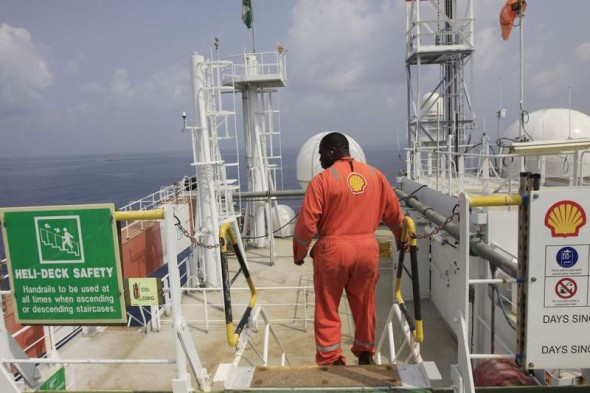
Photo: Royal Dutch Shell PLC
That’s a perfect line to sum up the oil industry in Nigeria.
Day two of the general strike and ongoing sectarian violence have pushed news of the Bonga field oil spill to the back pages, but in the end it’s all about oil. Whether it’s pollution on the beach, corruption or violence, the source of Nigeria’s malaise is oil.
But back to that line, “The polluter is strangely in charge of the regulators.” That’s from an editorial that appeared on January 9th in the Nigerian Compass.
Did someone say oil spill?
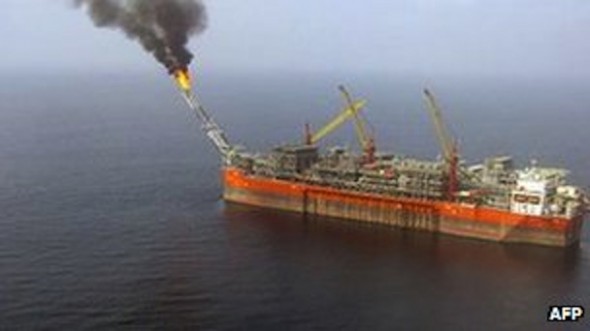
The FPSO that was the source of Nigeria's recent offshore spill. Photo: AFP
As the spill offshore Nigeria works its way to shore, the lack of information about what is actually happening is depressingly familiar.
Shell reports that less than 40,000 barrels were spilled (at 42 gallons per barrel, that’s something like 1.6 million gallons), but there’s no way to verify that information. Shell posted a photo of the source of the spill, a rupture in the line that carries oil from the offshore storage facility (the FPSO) to oil tankers.
Off the radar…
Takoradi, Ghana. Photo by Christiane Badgley
I’m working on a story about the regulation and oversight of the offshore industry across the Gulf of Guinea and should be wrapping it up in a few weeks. That’s been keeping me from posting much lately.
Three weeks have now passed since the spill in the Ahanta West District. I am still unable to communicate any official, on-the-record information about what happened. A few days ago, the Ghana EPA said that the whale deaths in the Western Region could not be “attributed” to oil exploration, stating that there is no scientific proof for that claim. But the main thing to glean from the EPA statement is that no one knows what has caused the recent deaths. We can’t say they were provoked by the oil operations, but we can’t say they were the result of anything else, either.
There’s more news coming out about Jubilee’s production problems. When Ghana’s oil production began in December, the Jubilee partners estimated that production levels would rise to 120,000 b.p.d. within six months. But the “ramp up” has been delayed repeatedly and last month Anadarko, responding to stockholder concerns, went as far as saying that some well redesign was necessary. What had been a delay began to look like a real problem.
Cameroon: Did you say election?
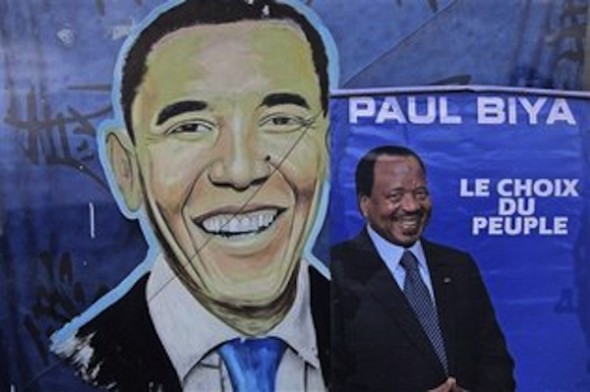
Yaounde, October 7, 2011. Photo: Sunday Alamba/AP
Do you know there’s a presidential election tomorrow (October 9th) in Cameroon?
Unless you’re Cameroonian or closely follow Cameroonian/African politics, you may not have heard anything about this election.
And yet…Paul Biya, president and favored presidential candidate, has been in office for nearly 30 years. That alone — in this year of massive political upheaval — would seemingly bring a bit more media attention to Cameroon’s upcoming election. If nothing else, one might ask why there’s no viable opposition in Cameroon and what this portends for the country’s future “stability” (“stability” being the grand achievement of Biya, who at 78, is not going to be around for much longer).
Shell in the Niger Delta: It gets uglier with each revelation
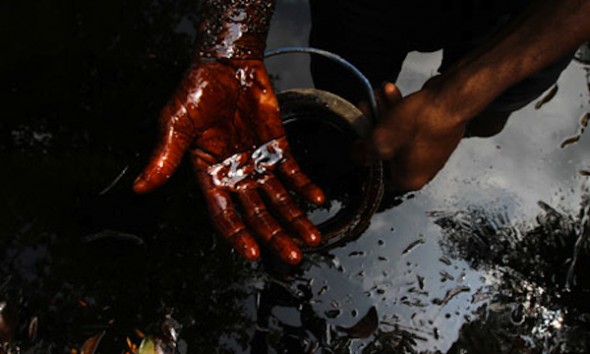
Shell oil activities in Ogoniland in the Niger delta have polluted rivers. Photograph: Akintunde Akinleye/REUTERS
Several damning articles have been been published in The Guardian (U.K.) over the past few days.
Sunday’s headline, Shell oil paid Nigerian military to put down protests, court documents show, gets right to the point.
John Vidal, Environment Editor, writes: “Shell has never denied that its oil operations have polluted large areas of the Niger Delta – land and air. But it had resisted charges of complicity in human rights abuses.
“Court documents now reveal that in the 1990s Shell routinely worked with Nigeria‘s military and mobile police to suppress resistance to its oil activities, often from activists in Ogoniland, in the delta region.
Gas flaring and Axim: an update…sort of
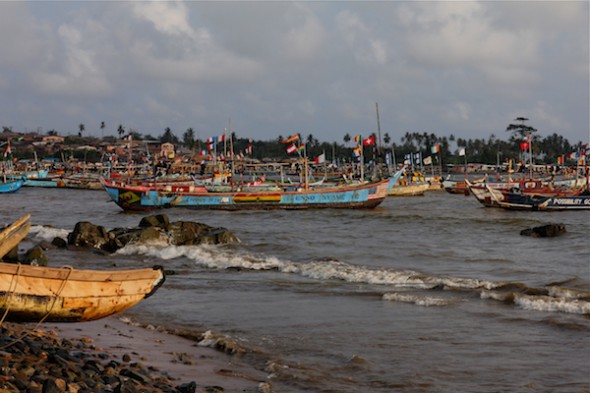
Fishing canoes, Lower Axim. Photo by Christiane Badgley
Last month I wrote about strange eye infections in Axim that some locals blamed on gas flaring. Axim, or Tired of Talk, I titled the post because local citizens were frustrated with talk that rarely seemed to get followed by action. When I visited Axim in August residents had been waiting several months for oil company officials to carry through on promises to send out a medical team for screenings.
An early morning in James Town
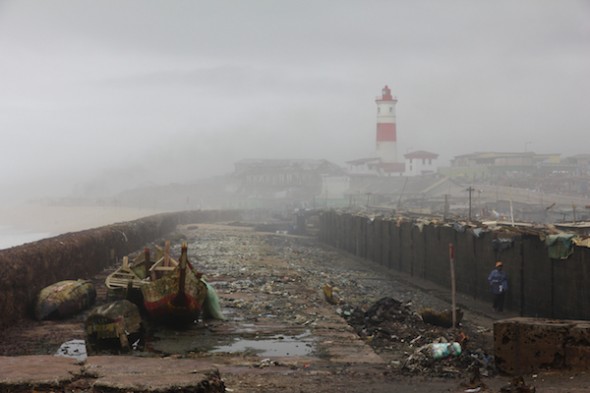
Photo by Christiane Badgley
It’s a gray and damp early morning in James Town. The lighthouse in the mist makes me think of northern California.
Libya, Gaddafi, oil: another view
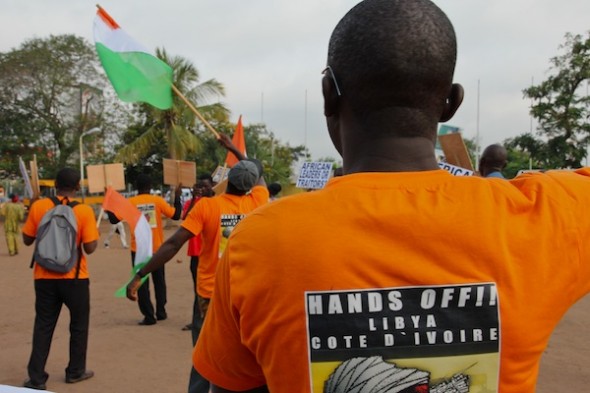
Hands off Africa demonstration, Accra. Photo by Christiane Badgley
On the African continent, a more nuanced appreciation of Gaddafi and the Libyan rebels.
While fighting continues across Libya, grisly details of the NATO-backed assault on Tripoli are beginning to emerge. At the same time the rush for Libya’s oil is on and it appears that the countries who provided early support for the rebels will have a competitive edge for new oil contracts (read The rush to grab the trophy is on! in Arab News for more details on likely winners and losers in the post-Gaddafi era).
Can Europeans pressure their oil companies to do better in Africa?
Chatham House has released a new study on the impact of oil companies on health and the environment in Africa. The study, prepared for the European Parliament, covers the problems associated with oil production in Africa and suggests what European citizens can do to affect change. There are a number of ways that Europeans (and Americans) can engage with their oil companies and governments to push for more effective regulation and better business practices. The article I’ve posted below, from IDN, reminds European readers that they need to take an active role in working for a better (cleaner, safer, more transparent) oil industry in Africa.
Revelations in the Economist: The Queensway syndicate and the Africa trade
Anti-corruption campaigner, Global Witness, has released the results of a months’ long investigation into the shadowy China Sonangol syndicate. The Economist ran an in-depth feature article on August 12th based, in part, on the Global Witness investigation. China Sonangol, known also as The China International Fund or the “Queensway Syndicate” is a corporate partnership that started trading oil in Angola and now operates in oil markets around the world. The Economist article is a must-read for anyone interested in oil and the so-called “resource curse.” The Global Witness report provides more information, as well as proposals for curtailing this type of illicit trading.
Axim, or Tired of Talk
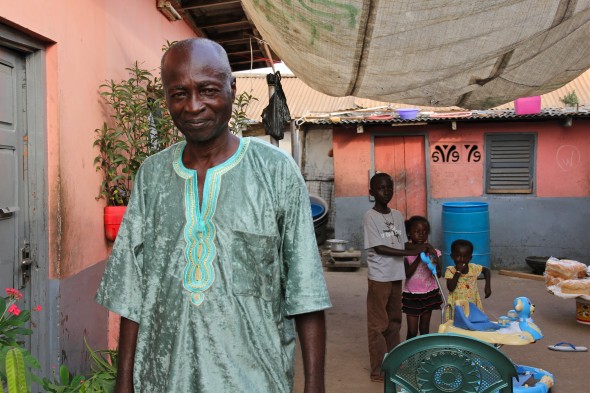
Nana Kojo Eshun, Chief Fisherman, Lower Axim. Photo by Christiane Badgley
I took a trip to Axim today. Axim is a town about an hour’s drive west of Takoradi. It’s a major fishing port, one of the largest in Ghana. There are 800 fishing canoes operating out of Axim and some of the big canoes have 20 person crews. So from Brewire to Apewosike, there are literally thousands of people fishing in the Axim area.
I met with Nana Kojo Eshun, the chief fisherman of Lower Axim. I wanted to talk to him because I’ve heard some stories from fishermen recently about health problems in Axim that some here blame on gas flaring in the Jubilee field.
UN report slams Shell in Nigeria
Niger Delta. Photo: Reuters
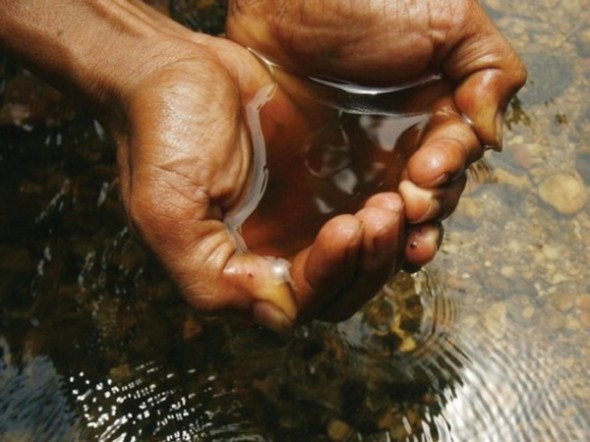
Justice is slow in coming in the Niger Delta — it has been 15 years since Ken Saro-Wiwa’s murder — but in the last few months there are signs of change in the air. On Wednesday, Shell formally accepted responsibility for two major oil spills in the Niger Delta (in 2008 and 2009):
In the first case of its kind, a British high court sitting in London has ordered oil major, Royal Dutch Shell to pay compensation of potentially more than £250m ($410m) to the Bodo community of Rivers State, after the Anglo-Dutch oil group admitted liability for two spills aroun the community, following a class-action lawsuit brought in England by the Niger Delta community. (from Nigerian publication, The Leadership)
Could Uganda Be the Next Niger Delta?
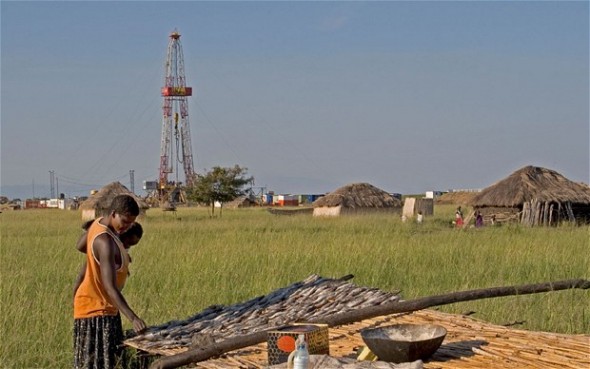
Oil Rig, Uganda. Photo: China Daily
Oil reserves in Uganda, where Tullow Oil is also a major player, may be significantly larger than original estimates and that doesn’t make everyone happy. Here’s an interesting article from the Center for Global Development. The Center supports direct payments of oil rents to citizens; it’s what they call “Oil-to-Cash,” and I’ve included a link to one of their reports on the topic.
Welcome news for Ghana’s fisheries
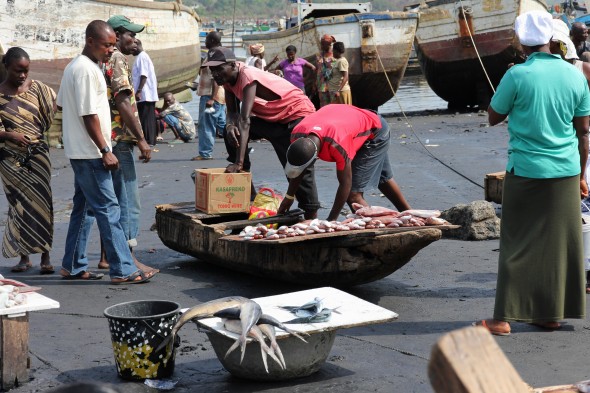
Disappointing catch at Sekondi Fishing Harbor. Photo by Christiane Badgley
The World Bank has announced a significant funding package (US$ 53.3. million) intended to support Ghana’s fisheries. Among other things, the funding will support efforts to reduce illegal fishing off the coast of Ghana and to improve sustainable management of the country’s fisheries. This is important news for Ghana’s fishing communities.