Oil, Money and Secrecy in East Africa
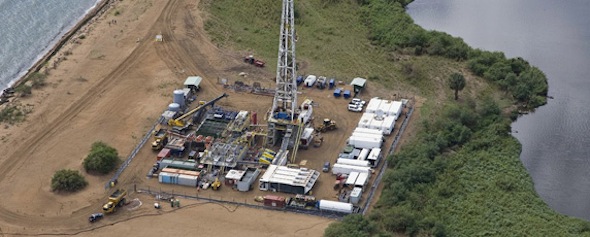
An aerial view of an oil-drilling site in Buliisa, Uganda. (AFP/Tullow Oil Uganda)
Tom Rhodes, the Committee to Protect Journalists’ East Africa Consultant, has written an interesting story on the secrecy surrounding oil development in Uganda, Kenya and South Sudan. Rhodes writes that the inability of journalists to access information and report on contract deals and resource allocation greatly increases the risks for corruption and environmental degradation. Last year I wrote a post on Tullow Oil’s secret deals in Uganda, contrasting that situation to Tullow’s much more transparent operations in Ghana.
After I published that story a Tullow Oil representative contacted me and explained that Tullow’s practices were dictated by local governments. Tullow can be transparent in Ghana because the government wants to be transparent. In Uganda, the official told me, the government does not want contract information published.
Limbe: conflicted tourism
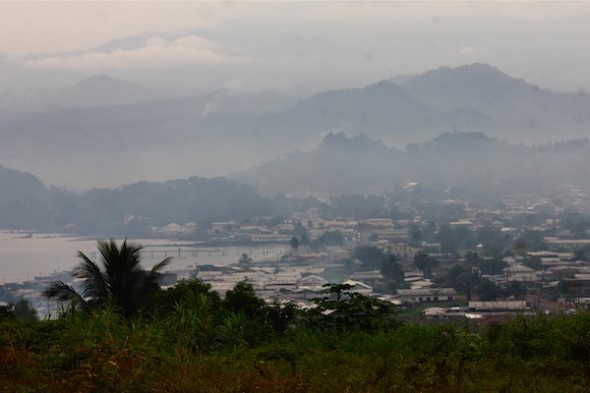
Limbe, Southwest Region, Cameroon. Photo by Christiane Badgley
Limbe, in Cameroon’s Southwest Region, is a gem. A coastal city famous for its black sand beaches, Limbe is located on the southern slopes of Mount Cameroon, one of Africa’s largest active volcanoes. The town is surrounded by lush forest and is home to the Limbe Botanic Garden, a 48-hectare expanse of majestic greenery bordering the Atlantic.
The Limbe Wildlife Centre is another one of the city’s attractions. The center was founded in the early 1990s as a rescue and rehabilitation center for orphaned primates. The first time I visited the center it was an open space. I’ll never forget the gorilla who stood on two legs and walked straight up to me as if he wanted to say something. Amazing. Today, the center is divided up into compounds and feels more like a zoo, but it’s still a great place to visit and marvel the biodiversity of this country.

Limbe Wildlife Centre. Photo by Christiane Badgley
But there’s more to Limbe than beautiful scenery.
Shell Nigeria ruling: Glass half full or…
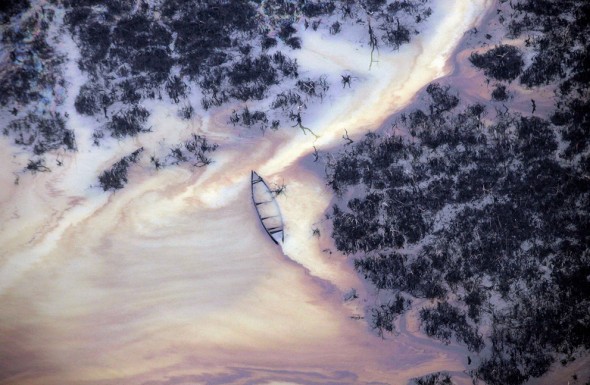
Oil flows past a sunken boat in a creek near an illegal oil refinery in Ogoniland, outside Port Harcourt, in Nigeria’s Delta region, on March 24, 2011. (Photo: Sunday Alamba © Amnesty International
Last week’s Dutch court ruling in the case brought by four Nigerian farmers against Shell for oil pollution damage is being reported as a “victory” for both the plaintiffs and for Shell.
So, who really won? It depends how you look at things. Live Wire, Amnesty International’s blog, has a an excellent summary of the case and the ongoing challenges facing those who want Shell to clean up its mess in the Niger Delta. The court ruled in favor of one plaintiff and that is significant. Shell will have to pay compensation to the farmer and, according to Amnesty International, “This week’s ruling means Shell can no longer point to sabotage as if the company has no responsibility for this problem, and it should have wider ramifications for Shell’s Nigeria operations.”
Dutch court rules for plaintiff: Shell responsible for Nigeria oil pollution
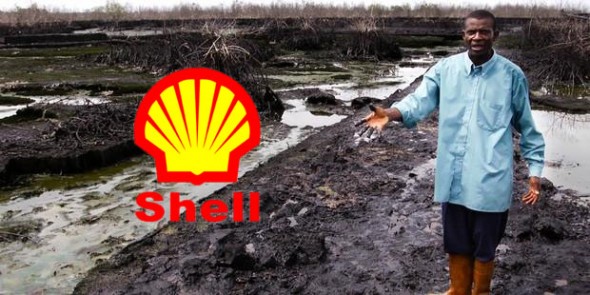
Photo: Association of Nigerians, Belgium, Amnesty International
A partial victory for plaintiffs in Nigeria may open the door to further legal action against Shell. From Reuters:
By Ivana Sekularac and Anthony Deutsch
THE HAGUE | Wed Jan 30, 2013 8:06am EST
(Reuters) – A Dutch court ruled on Wednesday that Royal Dutch Shell’s Nigerian subsidiary was responsible for a case of oil pollution in the Niger Delta and ordered it to pay damages in a decision that could open the door to further litigation.
The district court in The Hague said Shell Petroleum Development Company of Nigeria Ltd. (SPDC), a wholly-owned subsidiary, must compensate one farmer, but dismissed four other claims filed against the Dutch parent company.
Four Nigerians and campaign group Friends of the Earth filed suits in 2008 in The Hague, where Shell has its global headquarters, seeking reparations for lost income from contaminated land and waterways in the Niger Delta region, the heart of the Nigerian oil industry.
The case was seen by environmental activists as a test for holding multinationals responsible for offences at foreign subsidiaries, and legal experts said other Nigerians affected by pollution might now be able to sue in the Netherlands.
Offshore drilling, noise and whale deaths: is there a connection?
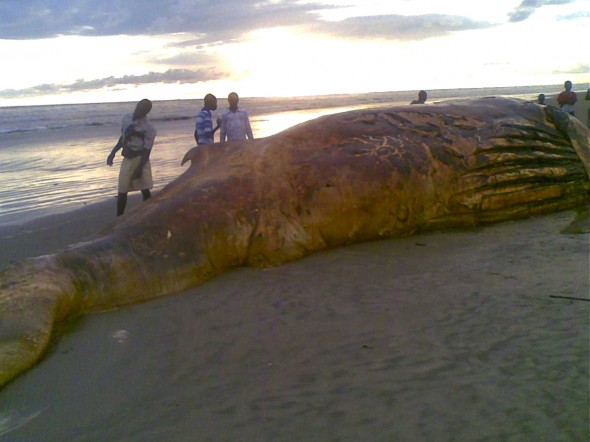
A dead whale in Ghana’s Western Region. Photo: Friends of the Nation
While working in Ghana last year, I learned that an unusually high number of dead whales had washed ashore since the start of oil drilling. I talked to several local environmentalists who feared the deaths were connected to the country’s oil industry but had no resources to investigate. Without offering any details or study results, the Ghana EPA declared the whale deaths were unrelated to the oil industry.
Although there had been no significant oil spills in Ghana, another form of pollution, which may have played a role in the whale deaths, was ongoing yet invisible: Noise pollution. Shipping and drilling are two known causes of significant underwater noise. Noise pollution — especially when it’s below the ocean surface — doesn’t get much attention. But as a recent article in the New York Times points out, the world’s oceans are increasingly noisy and the impact on marine life, mammals in particular, may be devastating:
Obama win: Dodd-Frank reform and EPA regulation won’t go away
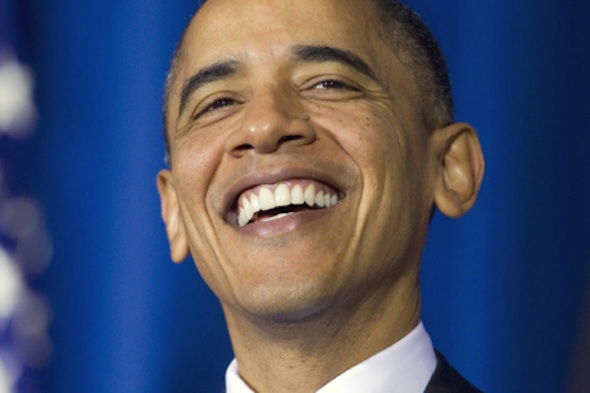
Photo: AP
Obama 2012 is not Obama 2008. Divided U.S. Gives Obama More Time, says the New York Times in an article about his “narrow victory”. Early this morning Obama told the crowds in Chicago that “the best is yet to come,” but we all know that — even with the best of intentions — he faces a bitterly divided government, a Republican majority in the House of Representatives and the toxic influence of corporate money on U.S. politics.
But keeping the Romney-Republican agenda out of the White House is significant. Romney had promised to repeal the Dodd-Frank financial reform that includes the important sections 1502 and 1504 that address the use of conflict minerals and oil and gas transparency, respectively. Sections 1502 and 1504 have already helped advanced similar legislation in Europe. And Romney repeatedly attacked the Environmental Protection Agency (EPA) and pledged to undo coal and fuel-economy regulation.
Insanity and the U.S. election
Forget the hope and change stuff, forget your disappointment with Obama — it’s time to get real.
For those in the U.S. who are not going to vote because they’re disillusioned or believe they must take a stand and vote for the Greens, this is the moment to swallow the bitter pill of realpolitik. Third party votes to the left of Obama will help Romney. Not voting will help Romney.
Go to the polls, cast your vote for Obama and then pledge to start fighting for real change on November 7th.
Obama and Romney have been competing for the title of “Fossil Fuels’ Best Friend,” but it’s not really a contest. The GOP has repeatedly shown it’s the party of deregulation, climate change denial and Big Oil. The Democrats may not be much better, but at this point we have to take what we can get and go from there.
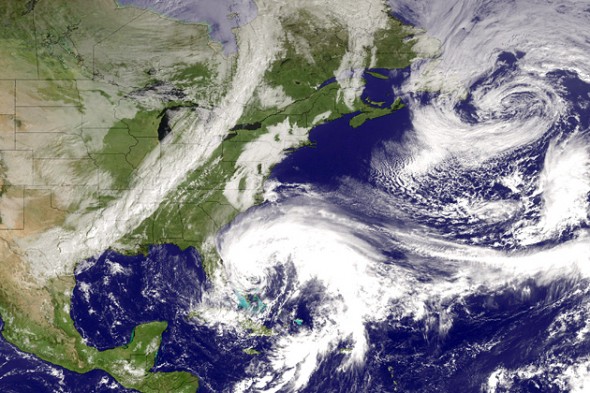
Sandy by NASA
Drilling ourselves to desolation
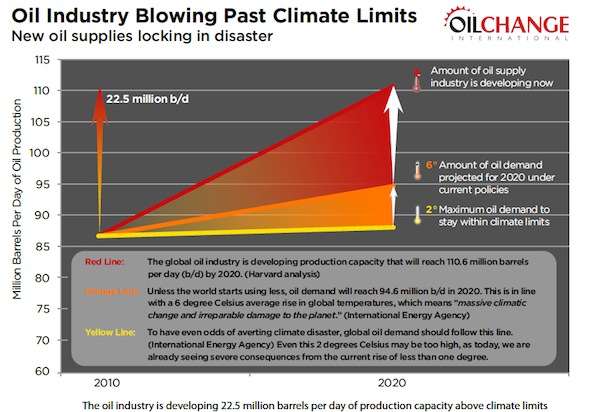
from www.priceofoil.org
African oil news today looks pretty much like any other day: a new paper from the European Centre for Development Policy Management warns that Africa must diversify to save itself from the resource curse. Nigeria is losing $1 billion a month to oil theft. The drilling race in East Africa is amping up and more gas is discovered in Mozambique. Meanwhile heavy flooding has wreaked havoc across West Africa, adding to the list of global extreme weather events.
There’s such a disconnect now between oil and weather stories that one could almost conclude that oil drilling and climate change are unrelated. But fossil fuel extraction and consumption have both immediate and long-term impacts on the the environment and those impacts are amplified across Africa. Most African countries are ill-prepared to deal with both oil spills and extreme weather events. And droughts, floods, coastal erosion and rising food prices will hit poor countries the hardest. Despite all this, there are only a few lonely voices calling to “leave oil in the soil.”
Did U.S. government downplay B.P. spill impact on wildlife?
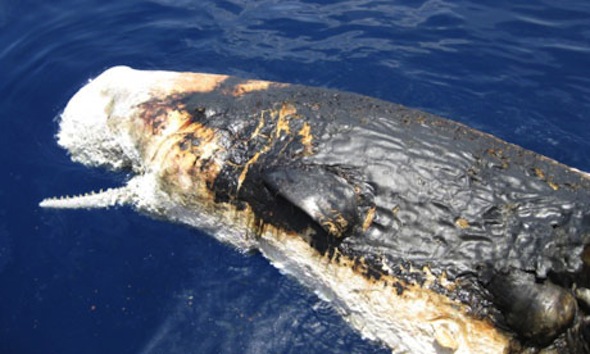
Photo: NOAA
Greenpeace has obtained a cache of NOAA (National Oceanic and Atmospheric Association) documents and photographs that suggest U.S. government officials kept information from the public in an attempt to downplay the environmental damage of BP’s 2010 Deepwater Horizon spill.
On June 15, 2010, NOAA crew aboard the research vessel, Pisces, spotted a dead sperm whale floating in the Gulf of Mexico. According to the Guardian, “NOAA did put out a press release about the dead whale. However, the release was edited and shortened in a way which appeared to minimise the effects of oil on whales.” The press coverage of the whale spotting was limited and it appears now that may have been the objective of U.S. officials.
New resource…and a bit of self-promotion
Takoradi, Ghana. Photo by Christiane Badgley
If you’re a reporter, student or activist looking for sources of information on the oil industry or wondering how you can work with data available from the World Bank and other organizations, there’s a new handbook out that you will certainly appreciate. It’s called, Exploring Oil Data, A Reporter’s Handbook, and you can download it from the Open Oil website. As someone who spends a lot of time sifting through (and trying to get my head around) data and searching dozens of websites for information that no oil companies willingly share, I was excited to find so many sources gathered together in one location. I was also thrilled to see my blog here at Pipe(line) Dreams listed as one of the “Top Ten Blogs”.
Shell on trial in The Netherlands
From the BBC News
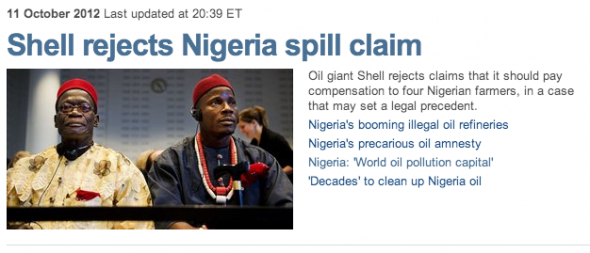
“For the first time in history, a European company, Anglo-Dutch oil giant Shall, has been brought to court in The Netherlands for damages it caused abroad. The plaintiffs are four Nigerians whose livelihoods and communities have been massively impacted by Shell’s operations.” From Friends of the Earth International. Read more and watch video here.
“If their case is successful it could pave the way for thousands of other compensation claims, says the BBC’s Anna Holligan in The Hague.” From the BBC. Read the full coverage of the day in court here.
ExxonMobil, Shell, abuse and accountability
Blood and Oil: Two major cases at U.S. Supreme Court
Mother Jones magazine has published, Did ExxonMobil Pay Torturers?, by Ian T. Shearn and Laird Townsend. The article details ExxonMobil’s possible involvement in human rights abuses in Indonesia and the victims’ decade-long struggle for justice.
“In June 2001,” the authors write, “John Doe III and 10 other civilian neighbors of ExxonMobil’s Arun natural gas facility filed a lawsuit against ExxonMobil in federal district court in Washington, DC. In John Doe v. ExxonMobil, the villagers charge the company with complicity in torture, arbitrary detention, and extrajudicial killings allegedly committed by Indonesian soldiers it hired to provide security.”
Shell in the Niger Delta: the endless wait for clean-up
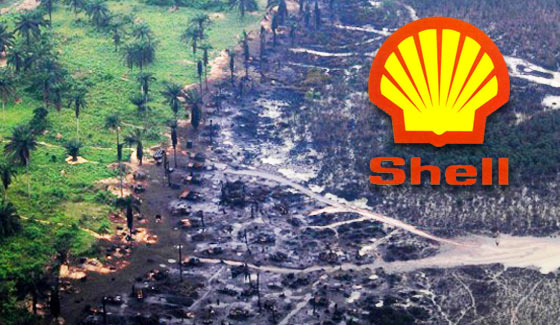
Photo from Sum of Us: Fighting for people over profits. http://sumofus.org/campaigns/shell-cleanup/
A team of assessors from the U.K. has just returned from a fact-finding mission to the Niger Delta and has slammed Shell for failing to clean-up pollution resulting from two 2008 spills. “Next to nothing has happened and where work has commenced it has been totally amateurish,” said said Martyn Day of the London-based law firm Leigh Day, speaking to John Vidal, environment editor at The Guardian.
You can read the article, Shell attacked over four-year delay in Niger Delta oil spill clean-up, for more details on Shell’s failure to get serious about cleaning up the extensive damage from the spills.
This is merely the latest in a series of damning critiques of Shell’s failure to clean up its pollution. Shell initially denied responsibility for the spills and when the company did accept responsibility it “dramatically underestimated the quantities” of oil spilled.
The resource curse: money and beyond
It’s time to connect the dots and add environmental impacts into the equation.
The resource curse — and how to break it — has been getting some much-needed media attention lately. Unfortunately, however, we’re not getting the whole story.
Oil spill offshore Nigeria worsening
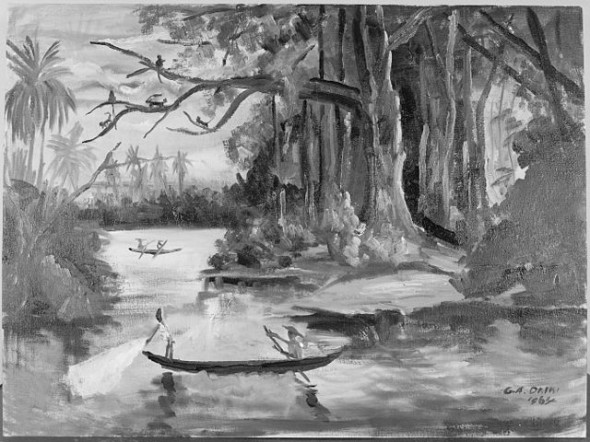
SweetCrude reports that an ExxonMobil spill off the coast of Nigeria is worsening:
THE oil spill near ExxonMobil oilfield off the coast of Ibeno, Akwa Ibom State, southeast of Nigeria has spread along the shore for about 15 miles, and locals said it was killing fish they depend on to live.
Mobil Producing Nigeria, a joint venture between ExxonMobil and the state oil firm, said this month it was helping clean up an oil spill near its Ibeno field in Akwa Ibom state, though it did not know the source of the oil.
Cameroon hires company for oil spill clean-up, nine years behind schedule
Marine loading terminal, Kribi, Cameroon. Photo by Christiane Badgley
You learn all kinds of crazy things reading the news. Cameroon Online published a story from APA news on August 19th, Une firme francaise va faire de la depollution maritime au Cameroun.
According to the story, Cameroon’s Societe Nationale des Hydrocarbures (SNH, the state oil company) has signed an agreement with French company, Le Floch Dépollution, for maritime oil spill clean-up operations.
Better late than never.
Oil pollution, sabotage and security
I’m finally back at my desk, catching up with news and writing.
Oil watchdog Platform has published a briefing, Dirty Work, revealing Shell’s financial links to human rights abusers in Nigeria.The company spends hundreds of millions of dollars on security forces to protect its workers while the suffering of local communities continues unabated.
This briefing arrives a year after the publication of a U.N. report that slammed multinational oil companies, Shell in particular, for a half century of pollution in the Niger Delta. A recent Reuters article, A year on, Nigeria’s oil still poisons Ogoniland, describes the situation today:
Pipeline news
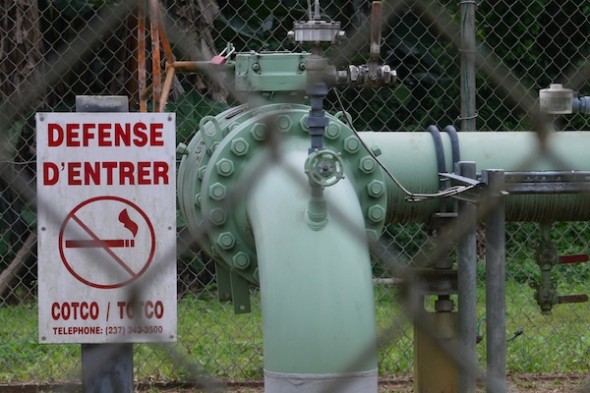
Photo by Christiane Badgley
Although the work I’m doing now in Cameroon is not directly related to the Chad-Cameroon pipeline, I’m getting updates on the pipeline as possible.
Last week I had a meeting at the Ministry of the Environment and Conservation and learned that Cameroon is once again trying to renegotiate the transit fees it receives for pipeline use. Although most of the pipeline is in Cameroon, which means that most of the environmental risk is in Cameroon, the country benefits only minimally from the operation. Most of Cameroon’s revenues from the project come in the form of transit fees collected on the oil pumped through the pipeline. Even at the time of signing, the rate (41 cents per barrel) was low and to add insult to injury, the transit fee isn’t indexed to inflation or to the cost of oil.
In the nine years that the pipeline has been operational, Cameroon has watched the price of oil skyrocket while its meager transit fees have remained unchanged. (See my December 2010 post on the lack of transparency surrounding Cameroon’s earnings from the pipeline.)
Kosmos Cameroon: Oil exploration in a national park?
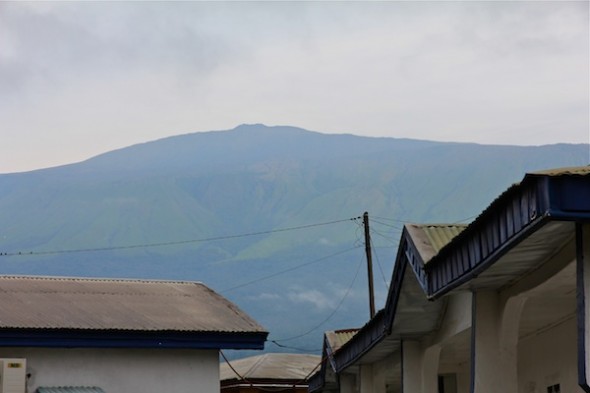
Mt. Cameroon, seen from Buea. Photo by Christiane Badgley
Kosmos Ghana gets most of the attention, but since I’m in Cameroon I decided to take a look at Kosmos Energy’s operations here. The company has a 100% interest in two onshore blocks, the Ndian River and Fako. Kosmos is also a non-operating partner (with a 30% interest) in a third block, the Kombe-Isepe. The company’s website provides some basic information on the blocks, including their size: “The company’s acreage position onshore Cameroon is the equivalent of more than 200 deepwater Gulf of Mexico blocks.”
Both the Ndian River and the Fako blocks are located in the vicinity of Mount Cameroon and the proposed Mount Cameroon National Park. In fact, a significant percentage of the Fako block is inside the proposed national park (Fako is another name for Mount Cameroon). The Ndian River block may also overlap the western edge of the park. The Kombe-Isepe block is located further east, between Douala and Edea.
There’s no information on the Kosmos website to indicate that the Cameroonian blocks are located in sensitive areas.
Ghana’s oil worries?
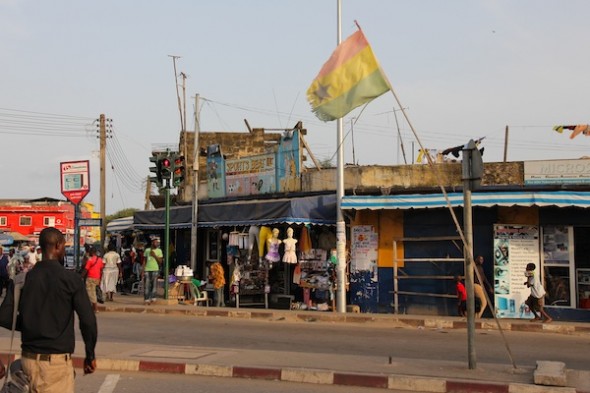
Takoradi waiting for the oil boom. Photo by Christiane Badgley
I have a decent internet connection this morning, so I’ll take advantage of that to post some of the back and forth between Ghanaian think tank, IMANI, and the Ghana National Petroleum Corporation (GNPC). IMANI has recently published some interesting articles on the Jubilee field’s underperformance. In contrast to the excited tone of most of the business news about the country’s oil industry, the IMANI articles raise serious questions about the industry’s costs and prospects.
Worrying Developments in Ghana’s Oil Sector discusses production levels that are hovering around 60,000 b.p.d. The projected 120,000 barrel daily output has never been met and at this time, it is unclear when production will reach this level. IMANI has questioned both the speed of the Jubilee field development and the original production projections.
Yaounde landing…
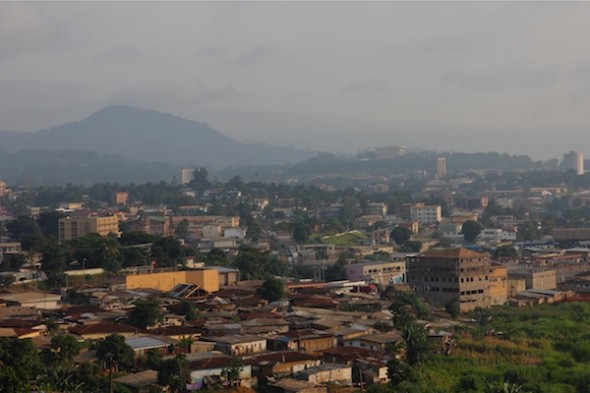
Early morning haze over Yaounde. July 2012. Photo by Christiane Badgley
I haven’t had a chance to post anything for a few weeks. I’ve just arrived in Yaounde, Cameroon, and hope to have more time to get information up in the coming days. I’m starting some new work and will look forward to writing about it.
In the meantime, I want to provide links to a few articles up at Ghana Oil Watch. As the months go by, the Jubilee Field projected 120,000 b.p.d. output level is looking increasingly like wishful thinking. It has been hard to get clear information on why — exactly — production is so low. Tullow and its partners have repeatedly cited technical issues as the cause, yet now that those issues are supposedly resolved, why haven’t production levels increased?
Oil and fishing, again
Fish vs. Oil Part 1 from Christiane Badgley on Vimeo.
I have been busy the past few weeks and haven’t had much time for posting…But today I have to take out a few minutes to repost an article from the Ghana News Agency (via Ghana Oil Watch).
It has been more than a year since I wrote about the difficult relationship between Ghana’s fishing communities and the oil industry. It seems that nothing much has changed since. The fishing communities are still waiting for an impact assessment. Fishermen say the oil industry is impacting their activities, but without any studies, they have nowhere to go with their grievances.
Continue reading . . .
U.S. Supreme Court: Shell Nigeria gets a boost from Obama administration
Democracy Now! May 26, 2009 report on opening of trial in NY federal court over Shell’s role in 1995 execution of human rights activist Ken Saro-Wiwa
Marco Simons, Legal Director at Earth Rights International, has recently written an article, US government sides with Shell over victims of crimes against humanity, which I’m posting below in its entirety.
Shell had asked the U.S. Supreme Court to rule the company can’t be sued by Nigerians seeking damages for torture and murders committed by the national government in the early 1990s. With a U.S. government brief that supports Shell’s position, where does this leave Nigerians? The U.S. brief suggests that the Nigerians should seek redress in their own courts, as the human rights abuses occurred in Nigeria and not the U.S. This is a chilling message.
Dirty oil, dirty money…time to rethink our drilling madness?
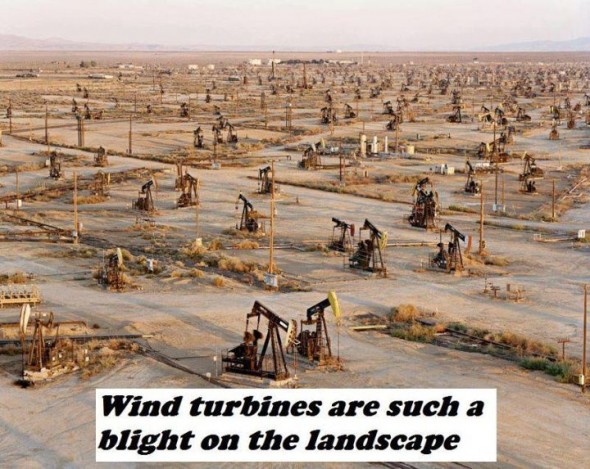
From DemocraticUnderground.com
I’ve not been writing much lately — too busy with other work. But a number of articles and reports have caught my attention.
Of course, mainstream reporting on oil is generally all good news. It’s the second golden age of oil! Drill, drill, drill. Oil and gas prices will drop! We will become energy independent! Oil and gas will transform economies! Investors will see great returns!
It’s all so wonderful that you can almost forget about climate change and corruption and the fact that we’re really not seeing oil money transform economies in a positive way. Not yet, at least. Oil is bringing in money and raising GDP, but that hardly means life on the ground is getting any better for the average citizen. And, as recent reports from Ghana suggest, oil there is boosting inflation and putting downward pressure on the cedi — hardly a benefit for the people.