Ken Wiwa, Nigerian author and activist, dies at 47

Photograph: Murdo Macleod for the Guardian
Gone, far too soon.
“The president of Nigeria has joined politicians, environmental activists and others to pay tribute to Ken Wiwa, the Ogoni leader and critic of Shell and other western oil companies in the Niger delta, who has died from a stroke in London.” Read the full story in The Guardian.
“Educated in Nigeria and Britain, Mr. Wiwa moved to Canada in 1999 and became a writer-in-residence at Massey College in the University of Toronto. He wrote features and columns for The Globe and Mail and was twice nominated for a National Newspaper Award….He wrote for many other international media, including The Guardian and the New York Times, and produced and narrated radio and television documentaries for CBC and BBC.
“Mr. Wiwa returned to Nigeria in 2005. Believing that he could help Nigeria more effectively by working within the government, he served as a special assistant to three Nigerian presidents, including Goodluck Jonathan, with whom he worked closely. He worked as a special assistant on issues such as conflict resolution, reconciliation and international relations. Much of his work focused on the Niger Delta, still plagued by the environmental disasters that his father had tried to prevent.” Read the full story in The Globe and Mail.
Shell Shareholders at Risk from Billion Dollar Nigerian Oil Scandal, says Global Witness
Following is a press release from Global Witness:
Shell‘s role in a billion dollar corruption scandal in Nigeria poses significant hidden risks for investors, Global Witness said at the company’s 2015 AGM. The warning comes as the oil major is lobbying the UK and US authorities to undermine the implementation of new transparency laws which would consign such secretive deals to history.
The corruption at the heart of the deal deprived the Nigerian state of over U.S. $1.1 billion, triggered investigations by authorities in three countries, and could potentially lead to Shell and its Italian partner Eni losing access to the oil block.
Deepwater Horizon spill: Five years later, endless problems
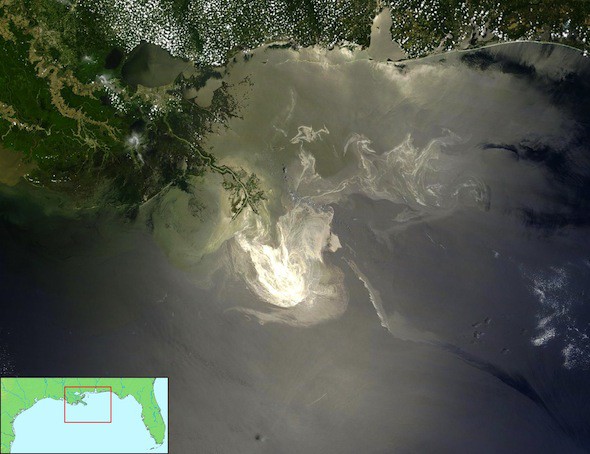
The oil slick as seen from space by NASA’s Terra satellite on 24 May 2010
Five years have passed since BP’s Macondo well exploded leading to the largest offshore spill in U.S. history. The story of the Deepwater Horizon spill no longer draws much media attention, but the problems have not gone away.
Teodoro Nguema Obiang loses his Malibu mansion

Exterior of Malibu home — U.S. Immigration and Customs Enforcement
A 2011 photo provided by U.S. Immigration and Customs Enforcement officers shows the exterior of the Malibu home of Teodoro Nguema Obiang, the second vice president of Equatorial Guniea.
It may be a drop in the bucket, but the Obiang family will forfeit personal property in the U.S. as part of a corruption settlement.
From the Los Angeles Times:
In a settlement filed in U.S. district court in Los Angeles, Equatorial Guinea Second Vice President Teodoro Nguema Obiang agreed to give up a $30-million house with a view of the ocean, a collection of Michael Jackson memorabilia and other property, including a Ferrari, to settle corruption claims by federal prosecutors.
The settlement with Obiang, who is the son and heir apparent to the nation’s president, is part of an expanding Justice Department effort — officials call it the “Kleptocracy Initiative” — to crack down on corrupt foreign officials who steal money and use it to live the high life in the U.S.
Oil vs. fishing in Ghana — the conflicts continue
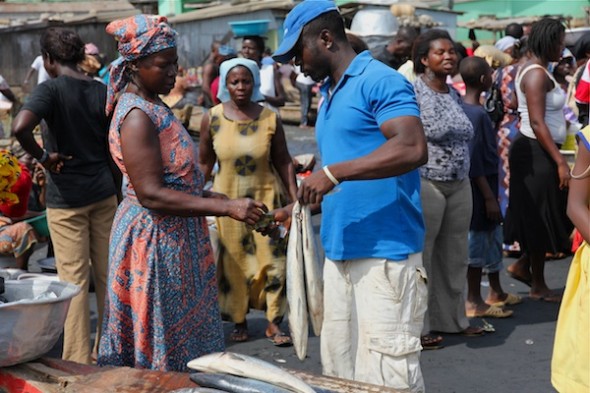
Takoradi fishing port. Photo by Christiane Badgley
It has been ages since I’ve posted anything here (more on that below), but it seems that nothing much has changed — at least not for the fishing communities of Western Ghana. I first reported on conflicts between fishermen and Ghana’s new oil industry more than three years ago. Since then, oil exploration and drilling have increased, and the situation for fishermen has deteriorated. In the last few months three reporters have contacted me to talk about conflicts between fishing and oil.
Tullow’s tax disclosures torpedo Big Oil’s campaign for secrecy
Tullow Oil, Ghana. Photo by Christiane Badgley
From Global Witness:
March 24, 2014
The UK company Tullow Oil today became the world’s first extractive firm to publish details of its revenue payments to governments broken down by each project the company operates worldwide. The disclosures, released today in Tullow’s annual report, show the taxes, royalties, licence fees and other public revenues generated by the company’s operations across 21 countries – 14 of which are in sub-Saharan Africa – for the years 2012 and 2013.
Tullow’s voluntary disclosures are being released in advance of a new EU law, due to come into force in the UK in 2015, that will require EU oil, mining and logging companies to publish their payments to governments on a project-by-project basis. These detailed disclosures will enable citizens in economically poor but resource-rich regions to monitor public revenues worth hundreds of billions of dollars and hold governments to account for how the money is used.
Better late than never: Cameroon renegotiates pipeline transit fees
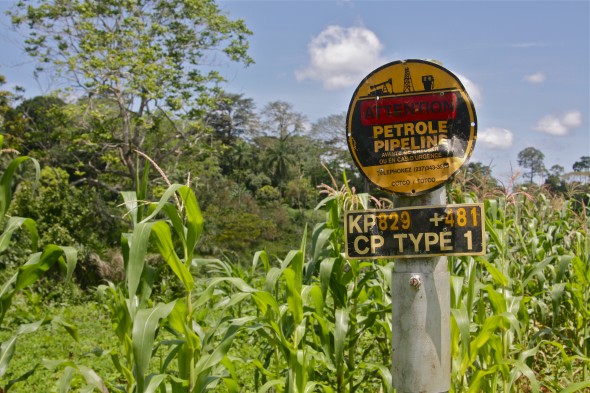
After ten years of operations, Cameroon has finally managed to renegotiate the paltry transit fees it collects on the Chad-Cameroon pipeline.
Cameroon will now receive 618.02 CFA francs ($1.30) per barrel of oil, up from 194.91 CFA francs. Since 2003 Cameroon was collecting less than U.S. 45 cents per barrel, a rate that was not linked to inflation or to the price of oil. Nor was the rate subject to regular review. Even the current rate, $1.30 per barrel, is low, but it will at least be raised every five years based on the rate of inflation.
The quantity of oil coming down the pipeline will soon increase as Niger has signed an agreement to use the pipeline. China National Petroleum Corporation (CNPC), the operator in Niger, will also use the pipeline for its Chadian operations. Exxon Mobil has not disclosed how much CNPC will pay to use the pipeline.
Read more:
Pipeline Tchad-Cameroun: Le droit de passage passe de 194 FCFA à 618 FCFA par baril
Niger awards second oil permit to CNPC, plans exports
What will it take for Ghana to investigate the surge in whale deaths?
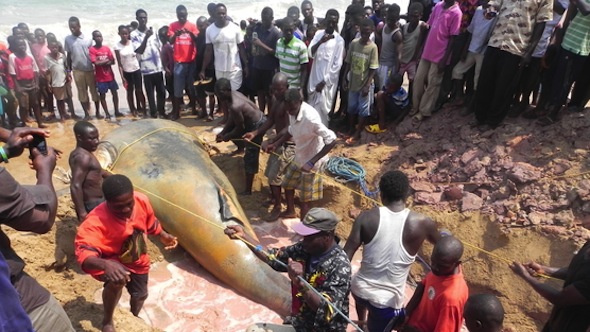
Photo: Friends of the Nation
An unusual number of dead marine mammals have been washing ashore in Western Ghana since 2009. Friends of the Nation and other local groups have reported the beached whales to the government and the local EPA office. The government has not investigated and the cause of the deaths remains a mystery. Locals point out that dead whales started appearing in 2009, coinciding with offshore drilling. Many suspect a connection between the whale deaths and Ghana’s oil industry, but without any studies people can only speculate.
Two years ago I wrote about Ghana’s oil industry for the Center for Public Integrity and included information on whale deaths:
Dead whales
In Sekondi-Takoradi, Ghana’s “Oil City,” activists from Friends of the Nation work with the communities closest to offshore drilling operations. In two years of monitoring on behalf of local residents, the group’s Kyei Yamoah, has noted an increase in whale deaths. “A whale washed ashore in October, bringing the total number of dead whales on our beaches since late 2009 to eight,” Yamoah said.
Marine mammals continue to wash ashore in Ghana’s Western Region
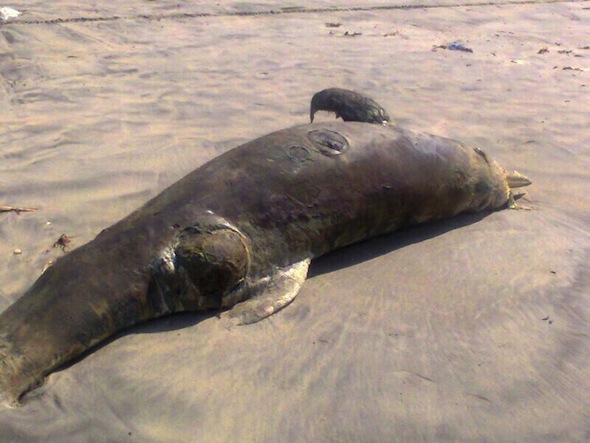
October 21st, 2013: the 19th marine mammal to wash ashore in Ghana’s Western Region since 2009. Photo: Friends of the Nation
From Friends of the Nation, Takoradi, October 23, 2013
The washing ashore of marine mammals in Ghana is still not stopping. On October 20 and 21, 2013, two more mammals were found dead at the coast of Asanta in the Ellembelle District in the Western Region. These carcasses present the 18th and 19th incidents respectively within the last four years. Citizens in the coastal areas are trying to correlate these unfortunate events to the offshore oil and gas, since the production started around the same period (2009). Two dead mammals after each other within just two days caused a shock amongst locals. People in the coastal community are asking for answers.
Chad’s oil: 10 year anniversary, nothing much to celebrate
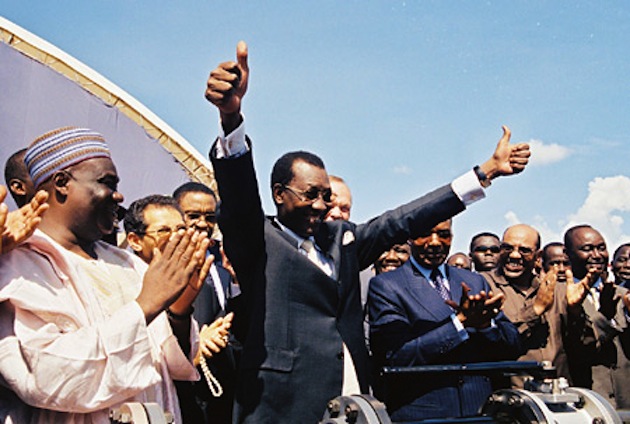
A crowning achievement! October 10, 2003
It was on October 10th 2003 that Exxon Mobil and its partners officially inaugurated the Chad-Cameroon Oil Project. The press release marking the event was positively jubilant:
Addressing inauguration attendees, Morris Foster, president of ExxonMobil Development Company, said, “It is with great pride that I am here today to celebrate this tremendous accomplishment with everyone who has been involved in the Project. I want to personally thank President Deby and President Biya for their support along with important contributions of our co-venturers, Petronas and ChevronTexaco, and the World Bank Group for their commitment to this Project.
“Today we celebrate not only what was achieved during the construction but Esso, as operator, also celebrates the manner in which it has been accomplished,” Mr. Foster added. “We maintained our long-term focus on this project over 27 years of effort and changes in the consortium, increased the known oil reserves to commercial levels and helped turn a vision in 1976 into a reality. We believe this project will help prepare a brighter future for the citizens of Chad and Cameroon, and I am proud we are part of it.”
U.S. sends mixed messages on transparency

S.E.C. in bed with the oil companies? Oxfam event in front of S.E.C., February 10, 2012. Photo: Oxfam America
The big news that came out of Obama’s recent trip to Africa was the announcement of his “Power Africa” initiative. The initiative has been praised and criticized, but I’ll just note the last few paragraphs of the White House Fact Sheet that discuss transparency — almost as an afterthought:
Transparent Natural Resource Management
The recent discoveries of oil and gas in sub-Saharan Africa will play a critical role in defining the region’s prospects for economic growth and stability, as well as contributing to broader near-term global energy security. Yet existing infrastructure in the region is inadequate to ensure that both on- and off-shore resources provide on-shore benefits and can be accessed to meet the region’s electricity generation needs.
Although many countries have legal and regulatory structures in place governing the use of natural resources, these are often inadequate. They fail to comply with international standards of good governance, or do not provide for the transparent and responsible financial management of these resources.
Power Africa will work in collaboration with partner countries to ensure the path forward on oil and gas development maximizes the benefits to the people of Africa, while also ensuring that development proceeds in a timely, financially sound, inclusive, transparent and environmentally sustainable manner.
Two steps forward, one step back
The Extractive Industries Transparency Initiative (EITI) adopted new standards intended to increase transparency in the oil, gas and mining industries. The new rules were announced in Sydney ahead of the EITI board meeting. Ironically, several of the major oil companies who sit on the EITI board are part of a U.S. lawsuit that seeks to weaken transparency legislation in the U.S. Inter Press Service describes the “disconnect”:
On the one hand, several of the world’s largest oil companies – including ExxonMobil, Shell and Chevron – sit on the EITI board and are thus inferred to be in agreement with the newly revised transparency rules.
On the other hand, these companies are currently part of a lawsuit here attempting to dismantle Section 1504 of the Dodd-Frank Act, the legislation on which the new EITI standards are mostly closely based.
Natural resources benefits for all?
The Africa Progress Report 2013 presented at the World Economic Forum on Africa created quite a media buzz. With its focus on natural resources — the extractive industries in particular — the report describes a continent “on the edge of enormous opportunity”:
Over the past decade, Africa’s economies have been riding the crest of a global commodity wave. Extractive industries have emerged as a powerful engine of economic growth. Surging demand for natural resources in China and other emerging markets has pushed export prices to new highs – and the boom shows no sign of abating. Africa’s petroleum, gas and mineral resources have become a powerful magnet for foreign investment. With new exploration revealing much larger reserves than were previously known, Africa stands to reap a natural resource windfall.
The challenge facing the region’s governments is to convert the temporary windfall into a permanent breakthrough in human development. Effective and equitable stewardship of Africa’s natural resource wealth could transform the region.
The report, Equity in Extractives, and more, are available on the Africa Progress Panel website.
Corexit and a never-ending supply of oil
Al Jazeera English is one of the few news organizations in the U.S. keeping the Deepwater Horizon story alive. While others have forgotten the disaster, Al Jazeera has broadcast a number of stories on the ongoing environmental problems in the Gulf of Mexico. The mess that oil made recently aired on Inside Story Americas.
The Huffington Post also featured an article by David Kirby on the Corexit scandal, Corexit, Oil Dispersant Used By BP, Is Destroying Gulf Marine Life, Scientists Say.
BP’s negligence prior to the Deepwater Horizon has been reported extensively. But had this accident occurred on land it could have been contained much more quickly. Today oil companies are after oil that’s harder and more dangerous to drill. Disaster response technology has not kept up and one can only when the next disaster will occur. A new article published in The Atlantic and Mother Jones, What if we never run out of oil?, describes the latest efforts to get at frozen gas miles under the ocean surface. A miracle — and a nightmare — writes author, Charles Mann. Indeed.
Deepwater Horizon spill: Three years on, terrible new revelations
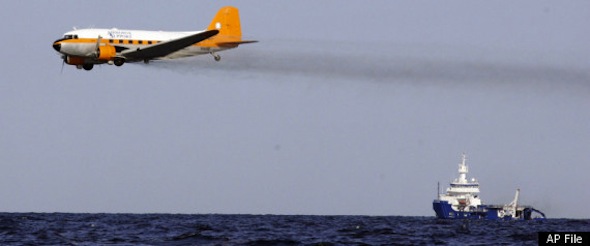
Dispersant spraying. AP photo.
What BP Doesn’t Want You to Know about the Gulf Spill is a new article by Mark Hertsgaard, and if you have ever wondered how the largest single, accidental oil spill in the world just vanished, don’t miss this story. It is an absolutely shocking recounting of BP’s massive, reckless use of the highly toxic dispersant, Corexit, which effectively “disappeared” much of the spilled oil and in the process caused untold damage to clean-up workers’ health and the ecosystem.
Three years after the spill, Herstgaard writes, the disaster has been largely forgotten. “Such collective amnesia may seem surprising,” he continues, “but there may be a good explanation for it: BP mounted a cover-up that concealed the full extent of its crimes from public view. This cover-up prevented the media and therefore the public from knowing — and above all, seeing — just how much oil was gushing into the gulf. The disaster appeared much less extensive and destructive than it actually was. BP declined to comment for this article.”
Kiobel v. Shell: U.S. Supreme Court issues decision
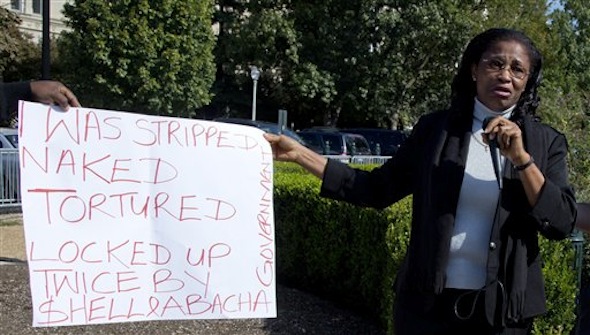
Esther Kiobel
Today the U.S. Supreme Court issued its decision in the Kiobel v. Shell case, limiting the courts’ ability to hear claims of human rights abuses committed abroad.
Lawrence Hurley of Reuters calls the disappointing decision, “a major victory for multinational companies,” adding that “the ruling is a major win for multinationals such as Royal Dutch that do business in the developing world and become embroiled in local political controversies.
“Those companies, which are still subject to lawsuits in foreign courts, fear U.S. courts because of the possibility of large damage awards,” Hurley writes. He goes on to note that, “The ruling is likely to affect other cases, including those involving similar claims against Anglo-Australian mining company Rio Tinto Plc over its conduct in Papua New Guinea; Exxon Mobil Corp over its activity in Indonesia; and Daimler AG concerning alleged abuses in Argentina. The companies have all vigorously contested the claims.”
Human Rights First goes further, saying the Kiobel ruling “undermines U.S. leadership on human rights.”
In its press release, the organization writes, “Today in its decision in Kiobel v. Royal Dutch Petroleum, the Supreme Court gutted the Alien Tort Statute (ATS), a law that has been on the books for more than 200 years and for the last 30 years has been a critical avenue to hold serious human rights violators accountable. In a decision that will undermine the United States’ status as a leader on human rights, the Justices unanimously decided that the victims of the gross human rights violations alleged in this case were not entitled to relief under the ATS. Furthermore, a majority of the Court ruled more broadly that the ATS does not apply to human rights violations committed in other countries.
A deaf whale is a dead whale
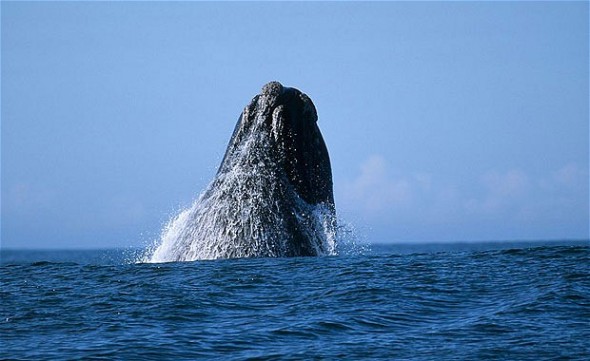
Whale off the coast of South Africa. Photo: http://www.telegraph.co.uk
That’s the title of a new report released today by conservation group, Oceana. The report, which focuses on U.S. oil exploration, shows, “that marine life and coastal economies along the Atlantic Ocean are threatened by seismic airguns used in testing for offshore oil and gas. The United States government itself estimates that the use of seismic airguns along the East Coast – an area twice the size of California, stretching from Delaware to Florida – will injure and possibly kill 138,500 whales and dolphins, and disturb necessary activities for millions more.”
Seismic testing doesn’t just happen in U.S. waters. Read Seismic tests enrage ecowarriors about environmentalists’ outrage when South African authorities admitted that “preliminary seismic tests had been ‘quietly’ conducted between the Port Elizabeth and Jeffreys Bay shorelines two weeks ago.”
More on South African drilling prospects (from an industry perspective) from Offshore magazine: Deepwater drilling on the way off South Africa
Greenpeace was already raising the alarm on the dangers of seismic testing ten years ago. But alas, the rate of offshore exploration has only grown since.
Some good background reading while waiting for the Kiobel decision
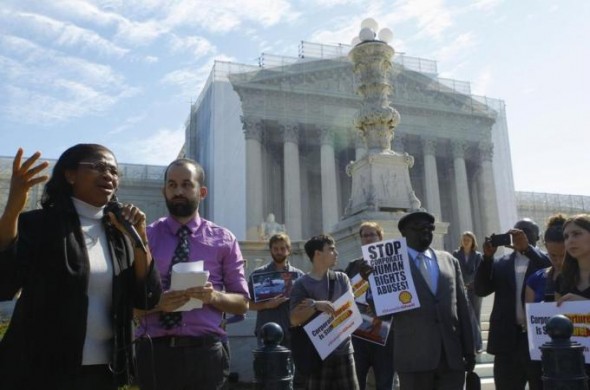
Photo: Reuters
“This may be the week that the Supreme Court finally issues a decision in the landmark Alien Tort Statute case, Kiobel v. Royal Dutch Petroleum,” international law expert John Bellinger wrote on March 24th. “Whether or not a decision is issued this week,” he adds, “most Kiobel watchers believe that the Court will rule in favor of Shell. But on what basis?”
He goes on to outline various legal theories that may persuade the judges (and leave human rights activists discouraged). Read the post here: Will the Supreme Court Issue a Decision in Kiobel This Week?
We’re still waiting for the decision and in the meantime I’m posting an opinion piece by Lauren Carasik, Director of the International Human Rights Clinic at Western New England University School of Law. This piece originally appeared on the Al Jazeera website. I’m posting the article in its entirety below as it gives a good overview of this case and the larger issue of transnational corporate liability for human rights abuses.
Indeed, as the Center for Justice and Accountability (CJA) writes in its overview of the Kiobel case, “The stakes are extremely high because the ATS is the only avenue for most human rights victims to hold perpetrators accountable. In the home countries of many victims, there is no legal forum available to seek justice. The Supreme Court is considering removing the U.S. as their last resort.
Another Exxon Mobil pipeline ruptures
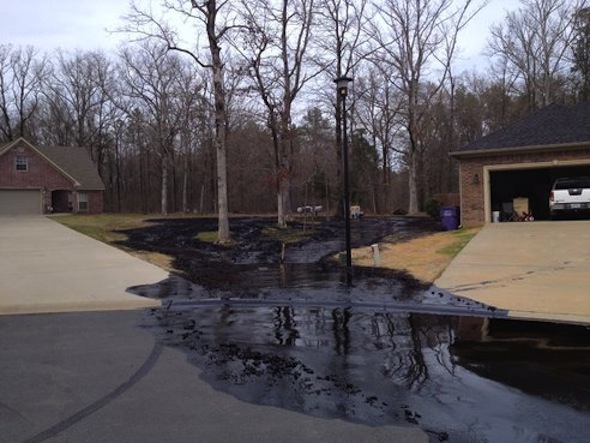
Photo: KARK News
Exxon Mobil pipeline problems are back in the news and this time it’s in Arkansas.
From InsideClimate News: A pipeline that ruptured and leaked at least 80,000 gallons of oil into central Arkansas on Friday was transporting a heavy form of crude from the Canadian tar sands region, ExxonMobil told InsideClimate News.
Local police said the line gushed oil for 45 minutes before being stopped, according to media reports.
Crude oil ran through a subdivision of Mayflower, Ark., about 20 miles north of Little Rock. Twenty-two homes were evacuated, but no one was hospitalized, Exxon spokesman Charlie Engelmann said on Saturday.
In an interview with InsideClimate News, Faulkner County Judge Allen Dodson said emergency crews prevented the oil from entering waterways. The judge issued an emergency declaration following the spill and is involved in coordinating clean-up efforts among federal, state and local agencies and Exxon.
Exxon fails to address pipeline safety risks, fined $1.7 million
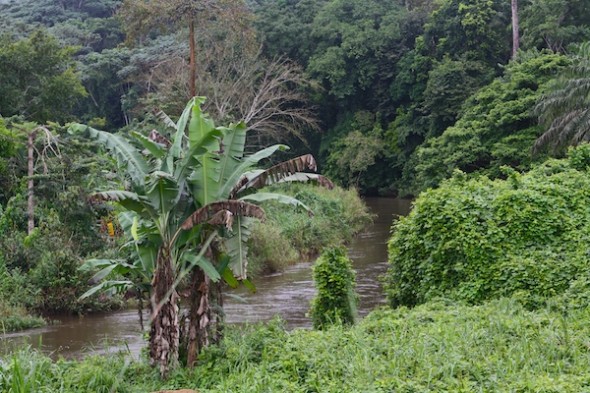
One of the many rivers that the Chad-Cameroon oil pipeline crosses. Photo by Christiane Badgley
“The U.S. Department of Transportation on Monday hit Exxon Mobil Corp. with a $1.7 million fine over a July 2011 pipeline failure that dumped more than 60,000 gallons of oil into Montana’s Yellowstone River after concluding the oil giant failed to effectively address pipeline safety risks,” writes Sean McLernon in the March 26th edition of Law360.
According to a news release from the Department of Transportation’s Pipeline and Hazardous Materials Safety Administration (PHMSA), “ExxonMobil failed to properly address known seasonal flooding risks to the safety of its pipeline system, including excessive river scour and erosion, and to implement measures that would have mitigated a spill into a waterway.”
I wrote about the Yellowstone River spill in September 2011 asking what lessons the Montana accident might have for Cameroon. To recap what I said then, environmentalists in Cameroon and Chad have long been concerned about the safety of the 1070 km Chad-Cameroon oil pipeline and have stated repeatedly that COTCO (Exxon Mobil pipeline operations in Cameroon) has not provided reliable information about its real capacity to respond in the event of an oil spill. Much of the pipeline crosses relatively remote and hard-to-access areas (few or no roads) and many question COTCO’s assertions that response teams could quickly travel to the scene of any incident.
Central African Republic and Chad

What happens next in Central African Republic is anyone’s guess, but Chad is likely to remain an important player in CAR politics.
Chad’s president Idriss Deby “lost patience” with Francois Bozize, as RFI reports, and along with Francois Hollande, ignored Bozize’s last calls for support. RFI asks why Deby, who helped bring Bozize to power a decade ago, recently turned against him. Read the RFI story, Centrafrique: Bozizé lâché par Déby, ignoré par Hollande. My translation/summary:
Deby’s entourage says the Chadian president was simply tired of dealing with Bozize. In May 2012 Deby went to Bangui and publicly called on Bozize to dialogue with the opposition. That was a sign of the tension already existing between the two heads of state.
In private, Idriss Deby reportedly asked Bozize to drop his plan to modify the constitution so that he could run for a third term…. Bozize had hard time accepting this advice from Deby who, himself, had modified the constitution of Chad to stay in power.
The crazy world of Nigerian oil
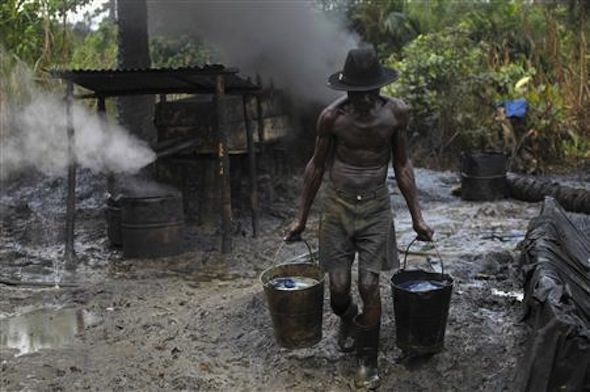
Ebiowei, 48, carries refined oil in buckets at an illegal oil refinery site. Credit: REUTERS/Akintunde Akinleye
Nigeria is experiencing difficulties selling its crude oil, but imports most of its refined oil products. No, that is not a mistake.
Nigeria Bearing Brunt of U.S. Shale Oil Boom is the title of a recent Wall Street Journal article. As the title suggests, increased domestic production in the U.S. has had a serious impact on Nigerian oil sales:
Exports of Nigerian oil to the U.S. almost halved between 2011 and 2012, according to (U.S. Energy Information Administration) data. In the late 2000s, Nigeria regularly shipped around one million barrels a day of crude to the U.S., but last year that number was just 405,000 barrels a day.
Other members of OPEC have also been affected. Exports from both Angola and Algeria fell more than 30% last year. But the impact has been the most severe in Nigeria, which has historically sent the bulk of its oil exports to the U.S., and the country has been forced to react.
Resentment grows in Chad after 26 soldiers die in Mali
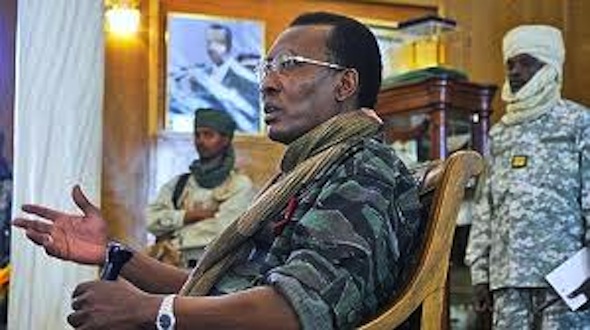
Photo: LeFigaro.fr
While debate continues in the Western press over Idriss Deby Itno’s claim that Abou Zeid and Mokhtar Belmokhtar are dead, news from Chad suggests there’s little support for Deby’s decision to send Chadian soldiers to Mali. Al Jazeera reports that, “Many in Chad are sceptical of Mali offensive.”
La Nouvelle Expression in Cameroon writes that Deby’s military move is an attempt by an old putchist to improve his image. Deby’s country is paying a heavy price, La Nouvelle Expression writes, but Deby accepts it courageously. For Chadian blogger Makaila the losers in Mali are the people of Chad. “Que toute l’opposition tchadienne se taise car désormais, Hollande, Obama et les autres, ne jureront que par (Deby).” (The Chadian opposition should shut up because from now on Hollande, Obama and the others will only swear by Deby.)
How many more jihadists and Chadian fighters need to die before all of Deby’s past sins are forgiven?
East Africa and the resource curse: Where are the jobs, where is the power?
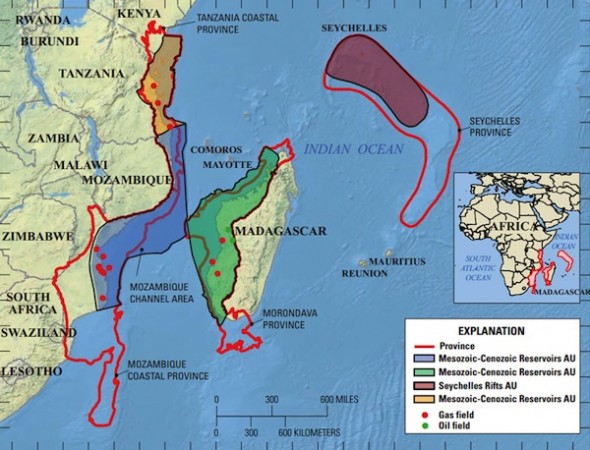
Lots of oil and gas, but will this translate into electricity and jobs? Map Credit: U.S. Geological Survey.
I’m catching up on news and have come across another recent article about East Africa’s oil and gas development. Avoiding the Resource Curse in East Africa’s Oil and Natural Gas Boom, draws attention to a fundamental problem with oil and gas development across Africa: minimal job creation and little or no increase in power (electricity).
Can any government really call oil a “blessing” if it doesn’t bring employment and power to the population?
The author, Jill Shankleman, is a senior scholar at the Wilson Center and former senior social and environmental specialist at the World Bank. “Up to now,” she writes, “oil companies and governments in developing countries have worked on a narrow model of economic benefit. Oil companies produce oil (and gas) for export. The government gets a hefty share of the profit in the form of taxes and product. To a greater or (often) lesser degree, efforts are then made to open up employment and supply chain opportunities locally.
“Where this model applies in West Africa, it is typical to find huge, state-of-the-art oil and gas export facilities sitting alongside communities where people live in houses without electricity. People like me who are involved in community consultations always hear the same thing when we speak with locals: ‘Where are the jobs? And why are we living in darkness next to this place which is stealing our oil?’”